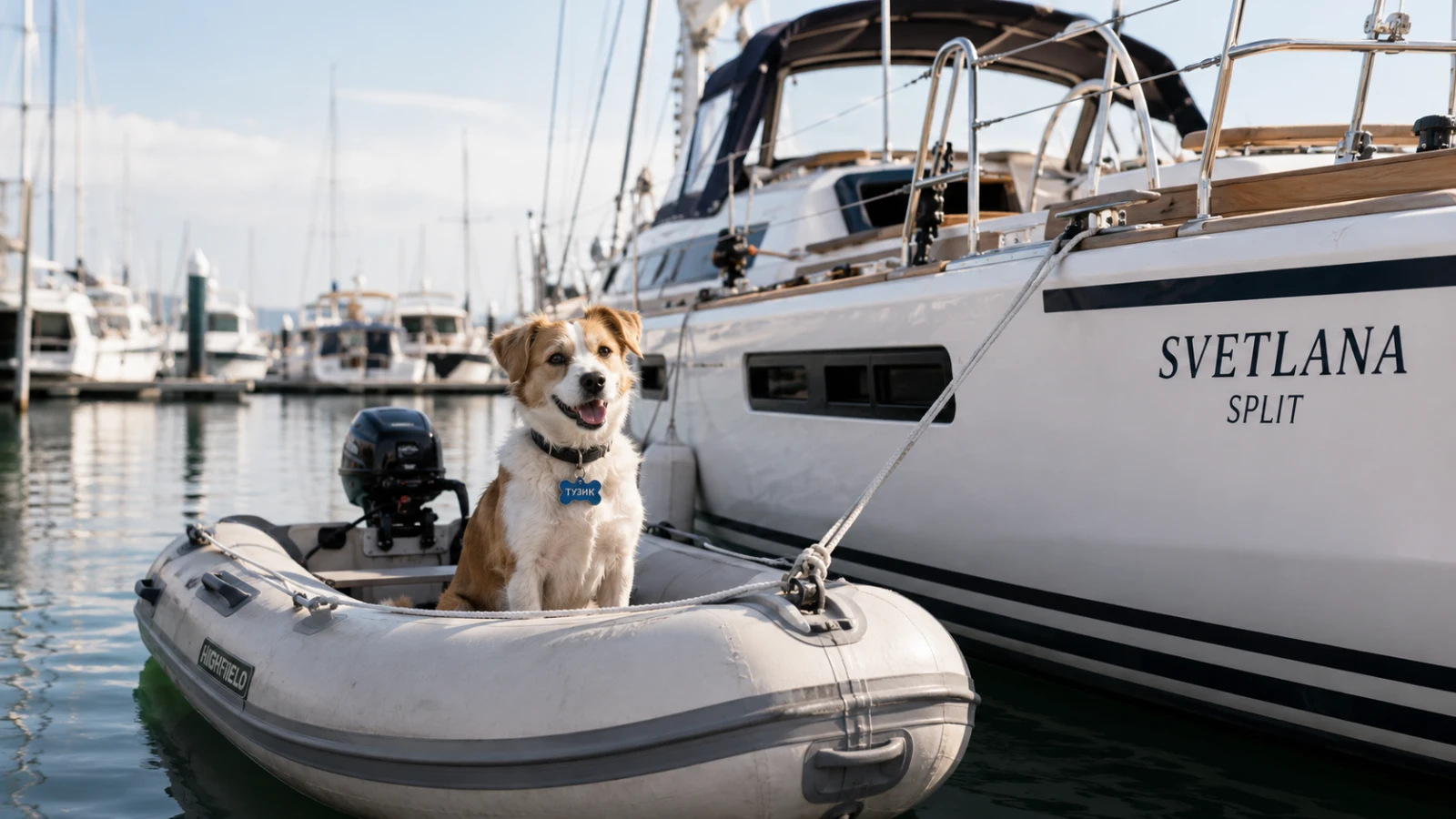
Every yacht gets most of the attention: the mast, the engine, the electronics, the galley, the proud name on the stern, and the expensive problems. But somewhere nearby, often tied alongside or dragged behind, there is the small boat.
It carries shopping, fuel cans, rubbish bags, wet shoes, children, dogs, and people trying to reach the shore with some dignity left.
In English, the small boat is often called a dinghy or a tender. Other languages have their own names for the same little helper, and they often notice different things about it: what it does, what it is made of, how small it is, or where the word travelled from.
The helper boat
Some languages describe the dinghy by its job. German has Beiboot and Dutch has bijboot. Both mean something close to “boat beside the boat” or “accompanying boat.” It is a plain description, but a good one: at anchor, the little boat is not just a separate object. It is part of how the yacht functions.
French has a similar idea with annexe. Outside boating, an annex is an addition, extension, or appendix. On a yacht, the annexe extends the floating home to the shore. Without it, the yacht may still be comfortable, but the crew is stuck looking at land from a very inconvenient distance.
The rubber boat
Other languages skip the romance and name the dinghy by its material. Italian has gommone, from gomma, meaning rubber. Finnish kumivene, Estonian kummipaat, and Croatian gumenjak all follow the same logic: this is the rubber boat. German adds Schlauchboot, closer to “tube boat,” which is also fair when the boat is basically a set of inflated tubes with a floor.
There is something nicely honest about this group. A yacht may have teak, stainless steel, polished fittings, electronics, and a serious name on the stern, while the tender next to it is sandy, patched, slightly underinflated, and one sharp shell away from becoming tomorrow’s repair job. It may not be glamorous, but on many cruising days it does more useful work than half the expensive equipment onboard.
The small familiar one
Some names make the boat sound small, local, and almost personal. In Estonian, julla is a nautical word for a small dinghy-type boat. It sits close to the Nordic jolle, used in Danish, Norwegian, and Swedish for small boats. For an Estonian sailing project, julla is a pleasing word to have nearby: short, local, Baltic, and easy to imagine tied to a marina pontoon.
In Russian, one especially memorable word is тузик. In boating, тузик means a small ship’s boat or yacht tender. Outside boating, Тузик is also a classic dog name. That makes the image easy to remember: the yacht has a small loyal companion that follows along, gets wet, gets dirty, sometimes refuses to behave, and still has to work every day. For a dinghy, this is not a bad description.
The travelled words
Some names have crossed seas before becoming ordinary. The English word dinghy comes from Indian-language words for a small boat and entered English through maritime contact. Portuguese and Spanish have lancha, now often used for a launch, small motorboat, or fast service boat, with an older story reaching toward Southeast Asian maritime vocabulary connected with speed and easy movement.
The word sampan is known internationally and comes from Chinese. It is often explained as “three planks.” The full history may be more complicated, but the image is excellent: a small working boat with a name that sounds almost like a boatbuilder’s materials list. French also has youyou, a real word for a small boat, playful in appearance but serious enough for nautical use.
Same boat, different eye
The funny part is that all these names describe the same basic thing, but they look at it from different angles. Some languages see the job: the helper boat, the side boat, the annex. Some see the material: the rubber boat, the tube boat. Some see the size and personality: the little local boat, the loyal companion. Some preserve old travel routes, where words moved between maritime cultures together with sailors, traders, fishers, and boatbuilders.
That is why the dinghy deserves more respect than it usually gets. It takes the crew to dinner, brings back the shopping, gets children to the beach, carries tools and rubbish, and teaches useful lessons about rowing in wind, starting small outboards, and tying knots properly.
Call it dinghy, tender, annexe, Beiboot, bijboot, gommone, Schlauchboot, kummipaat, julla, jolle, тузик, lancha, sampan, or youyou.
The big boat may be the home. The small boat is how you get ashore, come back, and still pretend everything was under control.

Comments
0 comments
No comments yet.
Please log in or register to leave a comment.